Thank you for your kind message! I've been thinking about another project for the 16k ZX Spectrum, but I know this one wouldn't fit in 16k. I stuck with the 16k machine for my ZX projects because assembly language programming is tedious and I thought the 16k machine was least likely to exhaust my patience or to allow feature creep. I'm not ruling out writing 48k games, which Chambers probably would be, but that's probably something for the more distant future. I still have a lot of DOS projects in my head!
Cyningstan
Creator of
Recent community posts
Thanks for your comment! I'd definitely recommend getting hold of these machines, but there are things you have to look out for because of their age. The issues I can think of right now are: (i) check for evidence that it works; in online sales you want pictures of the machine switched on, with a screen display lacking blotches or missing vertical pixel lines, (ii) check that the hinges and surrounding area aren't cracked or broken.
If you find a machine that looks fine there might still be minor problems with it that can be worked around. The machines have a metal tongue that sits between the two AA batteries, and in a few of my machines that's broken or missing, but you can still power the machine up by inserting a piece of foil between the batteries to make the contact. The batteries are awkward to put in with this problem but you get the knack of it soon enough.
Since these machines are battery powered, all you really need are the computer itself. But to get 3rd party software onto them you'll also need the 3-link, a serial cable with a dongle in the middle containing a ROM with the comms software (a Series 3c or 3mx don't need the dongle as they have the software in ROM, but their cable still has a bespoke connector at the Psion end). And to connect to a modern machine you'll need a USB-to-serial adapter.
You'll probably want memory cards for storage too, proprietary cards called SSDs (solid state disks) on the S3 family. There are two types: Flash SSDs, where space is not freed up by deleting files and are therefore more suitable for archiving or storing the software itself, and RAM SSDs that work like modern storage and are therefore good for files that get saved often. I especially recommend a Flash SSD for installing software to so that it's not taking up main memory, especially on machines with 128k or 256k of memory.
I hope this helps; if you need more information let me know!
I love much of what Psion put out in the consumer market, from the Organiser II to the EPOC32 machines. I especially love the ability to develop on the device itself. The original Series 3 is my current favourte - enough power for the projects I want to do, without the extra complications of stylus input or the need for better artwork.
Thanks for your comment, and Merry Christmas to you!
It probably takes a few games to get the strategies down. I can't say how many, as I was learning as I was writing it (the original version 15 years ago). But you might also have just been unlucky. If your cities are far away from the barbarian invasion and there's a bunch of mountains or forests in the way, they'll have chance to build up their numbers before you get there.
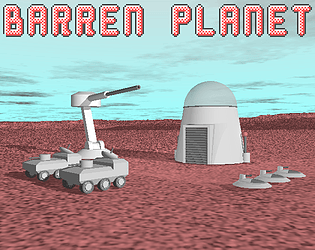
Sorry, I took down my Github recently and haven't updated all the old blog posts. You can download the source code from my web site now: http://dos.cyningstan.org.uk/downloads/7/barren-planet
Here's my WIP, a simple little strategy game with CGA graphics. It's more or less done, I just need to finish the title screen music and the manual cover. I've been a bit distracted by real life stuff, and by working on my game programming library (part of which is a utility to build the aforesaid music), so progress has slowed down a little.
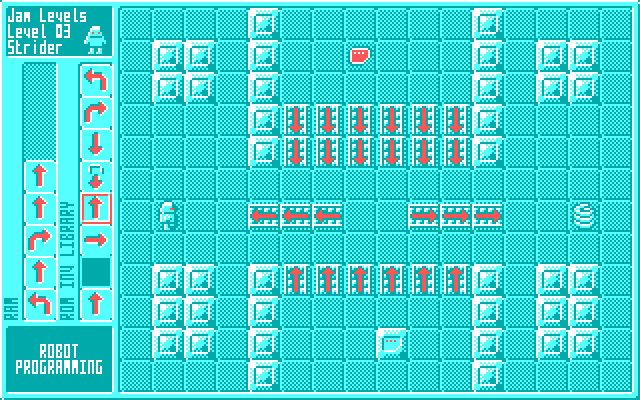
Thanks! I've bookmarked your blog now and look forward to future articles. As for dying: have you checked the 1-page Quick Start guide? If you're dying early and often, you might not be buying the right equipment for your character. The quick start guide gives you hints at what equipment best matches the skills your character has.
Thanks for the kind comment!
The menu system is inspired by that of Battle Isle 2, holding fire while selecting the option. Since the default is context sensitive, it means you can just tap fire to do the most likely option (move when pointing to an adjacent empty square, heal when pointing to an adjacent injured colleague, attack when pointing at an enemy, etc). But the shortcuts are useful when the thing you want to do *isn't* the default option.
This particular game is just a proof of concept for the tactical combat engine. I hope to make other games in the Star Cadre series with a variety of campaign modes. So in future you might be able to take Medic Usteme's career further.
Some examples from the early CGA era might be good candidates to DOS-ify the project a bit more. Bouncing Babies and Sopwith come to mind, with their simple mechanics. Although Spacewar is older than DOS, the DOS version is well regarded. I'm sure there are some obvious DOS exclusives I've forgotten.
That's looking really good! I'm glad you're finding CGALIB useful! In my latest update I forgot to expose the screen attributes too, but it's relatively simple to do. I'll probably get around to that once another update is necessary.
The new bitmap editor is still a bit limited (24x24 tiles, and only 24) because it's really only there to get people started. Your own is probably better for your purposes. For my own projects I'll probably continue using The GIMP to make screen-sized collages of bitmaps and writing a bespoke asset maker for each game to grab the bitmaps.
I'm looking forward to seeing where your RPG project goes.
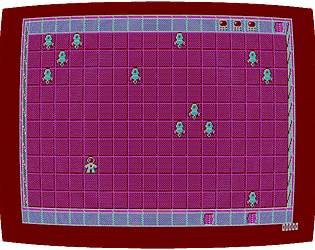
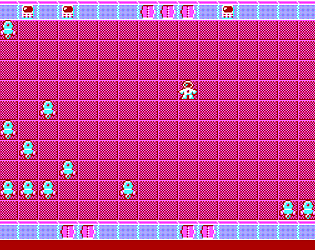
You've got the gist of the game. It's a remake of a traditional robot chase game from the 1970s or 1980s. Get all the robots on each level to destroy themselves, teleporting only when necessary to survive. Once all the robots are trashed, you go on to another level with more robots. Eventually you will die, in true 1980s game style. The doors and terminals are for decoration only.
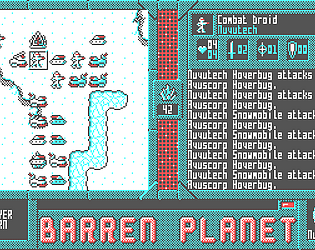
I've tried other palettes but settled on this one (with a red background instead of the usual black) as I find it a bit more attractive than the default black/white/cyan/magenta. The Barren Planet or Team Droid palettes would be better but I'm trying to use a different palette for each game I release. There's always the monochrome option if you don't like the colours :-)
Thanks! Tiny BASIC is a good subject for a first attempt at an interpreter or compiler, which is why I think there are so many implementations old and new. The only disappointing thing is that there isn't a bigger library of programs for it, given that it's been around in one form or another since the 1970s. I'll go an have a look at those discussions now.
This looks really interesting! I've had a quick play with it and have a question: when I press 1 to advance up the track, it doesn't advance but just passes my turn and my power bar disappears. The monster can then attack me and then I have to start raising my power bar from the bottom of the track again. Am I misunderstanding the purpose of "advance"?